Alora
Executives drown in mail, promises and small bookings that a good assistant would just handle. Alora runs the inbox, tracks every commitment in both directions and books, schedules and pays at the level of autonomy the executive grants it. I designed and built all of it myself, and then cut it down to the three things that matter.
- Role
- Product design · Build
- Platforms
- Web · Desktop · iOS · Android
- Team
- Solo: designed and built by me
- Made at
- Techtify Labs · in-house product
- Disciplines
- Product strategy · Product design · UI/UX · Front-end
- Online
- getalora.io
Context
An executive's working week is mail, meetings and promises: "I'll send you the deck", "can you get back to me by Friday". A human assistant is valued for keeping those promises and for making the eleventh meeting not happen. Most AI assistants instead chat, summarise and chart your week back to you.
Who it's for
Executives in Europe who would hand work to a chief of staff, and the compliance people who have to approve the vendor.
Constraints
- 01Trust is earned per action. Nobody lets software send mail or spend money on their behalf on day one.
- 02Data has to stay in the EU, so hosting, payments and model choices are part of the offer.
- 03Paying unattended is hard. Storing a customer's card and CVV to type into checkout forms breaks PCI DSS, so Alora only pays where a merchant has an API, through a Mollie mandate.
- 04Four clients (web, desktop, iOS, Android), designed and built by one person.
My role
I designed the product and wrote all of the code across the web app, the desktop app and the mobile app. I also wrote the product-focus doc that cut the product down to three pillars, and then carried out the cut.
- Product strategy and the three-pillar focus
- The autonomy model, approvals and undo
- Interaction design for web, desktop and mobile
- Web, desktop and mobile front-ends
- Privacy and payment flows with the EU stack in mind
Key decisions
The calls that shaped it
Cut the product to three pillars
- Problem
- After many rounds of features the web app had 26 pages: wellbeing scores, media watchlists, screen observation, rhythm charts. The offer couldn't be said in one sentence, and most pages were analytics about the user, not work done for them.
- Decision
- Keep only Inbox, Commitments and Execution. I cut wellbeing, intel and screen observation outright. Rhythm, reports, the shutdown ritual, search, history and memory were folded into the brief, the person drawer and a ⌘K bar.
- Why
- An executive opens a dashboard about themselves once. They act on a short brief from a chief of staff every day. Screen OCR would also never pass procurement at the companies worth selling to.
Autonomy is a dial per action, not an on/off switch
- Problem
- "Let the AI send email" is either too much or too little. People trust it with a scheduling reply long before they trust it with a payment.
- Decision
- Every action class gets four levels: Manual, Suggest (Alora drafts, you send), Auto with review (it runs after an undo window of up to 15 minutes unless you cancel) and Auto. Every autonomous action is logged with an Undo, and the settings page tells you how many actions Alora handled this week.
- Why
- People grant autonomy they can audit and take back. Starting at Suggest and moving up one class at a time matches how trust in a human assistant grows.
The phone is an approval button, not a second dashboard
- Problem
- The mobile app had a 700-line dashboard trying to be the web app on a small screen. The desktop app had five panels that copied the web dashboard, only worse.
- Decision
- One rule: the web app is the product. The phone keeps the brief, approvals, voice and in-room meeting capture. Approval pushes have Approve and Reject buttons, so you can say yes from the lock screen. The desktop app became a capture bar: meeting detection, system-audio recording, push-to-talk and a tray badge.
- Why
- Each client only carries what a browser can't do. Approving a booking while you walk between meetings is the one mobile action worth building an app for.
A quick "yes" only approves what was just asked
- Problem
- In chat, a short "ja" or "ok" approved the most recent pending approval from anywhere, so it could confirm a train booking that came from voice. Realtime voice also ran tools directly, so "boka tåget" booked and paid on the spot.
- Decision
- A quick yes now only resolves an approval raised in the same conversation, by the message right before it. Voice goes through the same approval policy: a gated call isn't run, it becomes a pending approval with a push, and the model is told it was not executed, so it says it's waiting.
- Why
- With money and outgoing mail, the worst failure is the assistant confidently saying it did something you never approved. Approvals have to stay tied to the context you saw them in.
Design system
The system
A dark, quiet workspace with one violet for action, taken from the purple chevron in Alora's logo.
Geist
Interface and marketing site
Geist Mono
Numbers, timestamps and code
- Glass cards with background blur over a near-black surface
- Status colours only for state: amber pending, green approved, rose rejected
- Shared translation catalogue across web, desktop, mobile and the API
Responsive
The front door
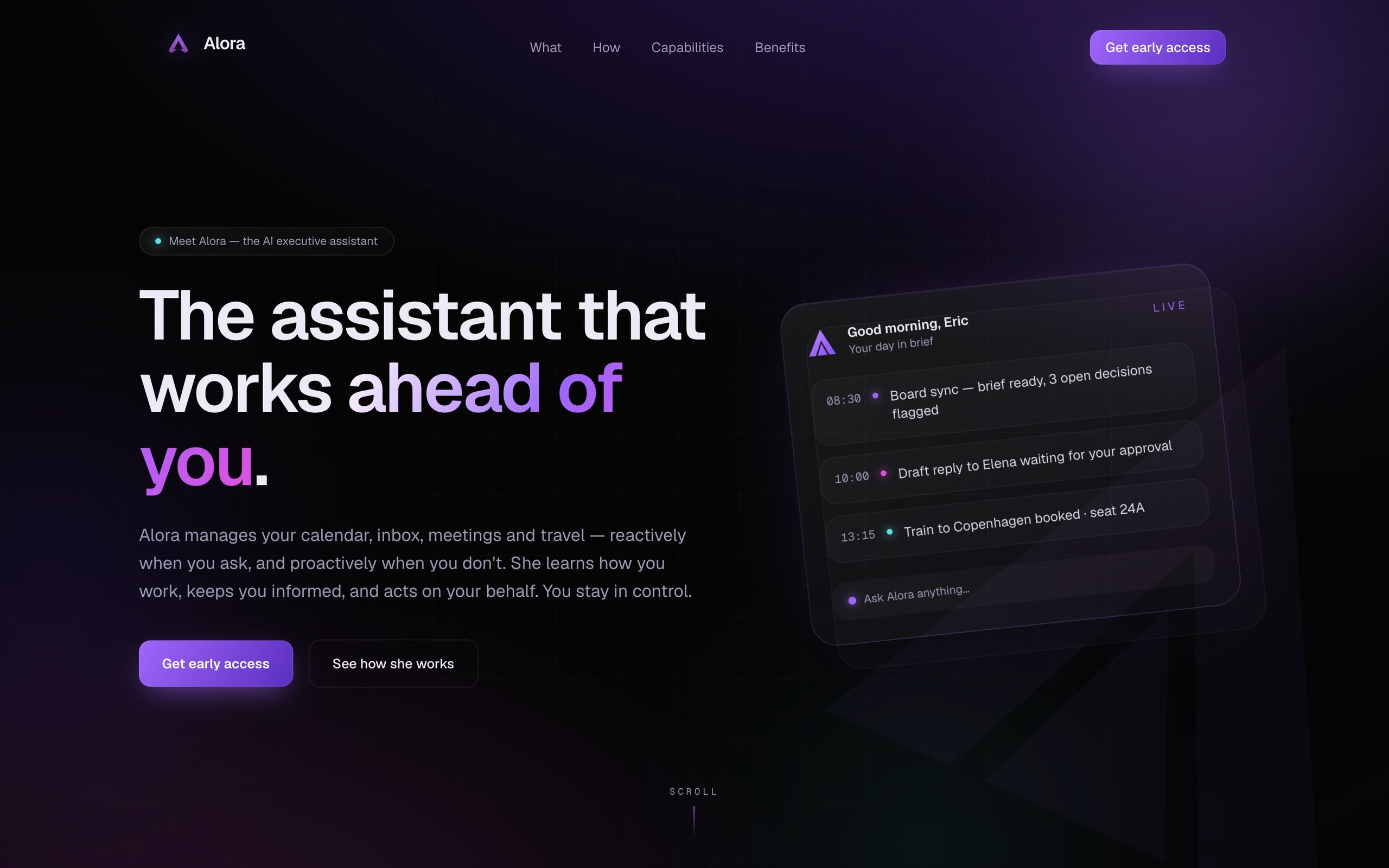
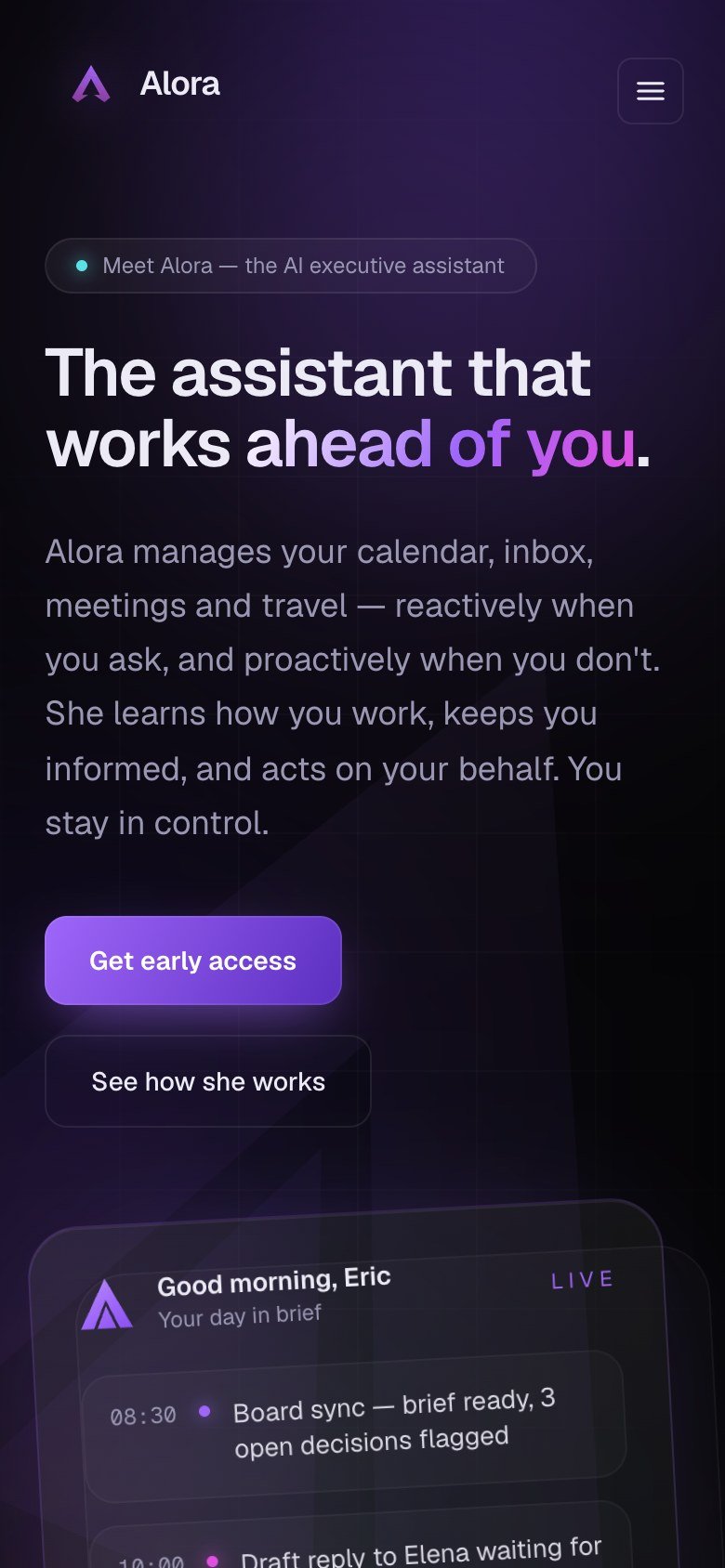
Dark, quiet and glassy: Alora should feel like a calm chief of staff, not another dashboard. The hero shows the morning brief instead of describing it.
The brief card is the product's first promise: your day, already handled. · 1440 px
“Stop measuring the executive and start doing their follow-up.”
— Alora product-focus doc
Outcome
Where it landed
The cut is done: the analytics pages, screen observation, background location and the duplicate desktop and mobile dashboards are gone. Rail tickets book and pay unattended through a Mollie mandate, and restaurant tables book through BokaBord. Next up are a chase engine for overdue commitments and turning the autonomy settings into a delegation contract you can hand to compliance.