Sasou
For SafePal Company AB
Sasou started as a consumer app for sharing your live location with friends and raising an alarm when you feel unsafe. It then pivoted to employee safety: people who work alone start a session, and a small safety circle of colleagues responds if something feels wrong. I led the design of both and built parts of the front-end.
- Role
- Design lead · Front-end
- Platforms
- iOS · Android
- Team
- Niklas and me at Techtify
- Made at
- Techtify AB · for SafePal Company AB, where Techtify held equity
- Disciplines
- Product design · UI/UX · Front-end
Context
Sharing your location usually means a permanent trail of where you've been, and very few apps help in the moment something feels wrong. For people who work alone (home care, security, field service), "something feels off" is a daily risk with no good way to flag it.
Who it's for
First, friends and families who want to look out for each other. After the pivot, employees who work alone and the colleagues who respond for them.
Constraints
- 01Location is sensitive, and tracking at work even more so. Trust is the product.
- 02The alarm has to work in seconds, yet a false alarm can't cause panic.
- 03The B2B MVP was built for a short real-world trial, so it had to stay lean: no escalation chains, no customer dashboard, no custom design layer.
My role
I led the experience and interface design for the consumer app and for the B2B MVP, and built parts of the React Native front-end. In the pivot I turned the concept into a lean, testable MVP for a trial with employees.
- Alarm, location sharing and group flows in v1
- Visual direction around the Sasou peach
- Scoping the B2B MVP: session, Heads-Up and the responder view
Key decisions
The calls that shaped it
Real time only, nothing stored
- Problem
- Location apps ask for a lot of trust and often keep a full history of where you've been.
- Decision
- Location is shared live and never stored as history. Sharing starts and stops with one tap, with the friends or groups you choose. Groups are private to the person who made them, so friends never see which group they're in.
- Why
- It's easier to share when nothing is saved. Hidden groups take away the social pressure of being sorted into "close friends" or not.
A Heads-Up, not an SOS
- Problem
- For lone workers, most risky moments aren't emergencies. If the only option is an SOS, people wait too long to use it.
- Decision
- The MVP's main action is a Heads-Up, with the hint "Tap if something feels uncomfortable or uncertain". A confirm dialog explains who gets notified. The user resolves it themselves with "I am OK - resolve".
- Why
- A lower threshold means earlier signals and fewer late emergencies. Letting the user close their own Heads-Up keeps it light enough to actually use.
Location only during a work session
- Problem
- Employees won't accept an app that tracks them all day, and a tool that isn't trusted won't be used.
- Decision
- Sharing is tied to a safety session the employee starts: a shift, a task or a route. Location is shared only while a session or Heads-Up is active, and the permission prompt says exactly that. Ending a session confirms that sharing stops.
- Why
- The employee decides when they're being watched over. That makes the product a safety net instead of surveillance.
Flow
The consumer app (v1)
Dark by design, so it can be used discreetly at night. Every screen keeps the alarm within thumb reach.
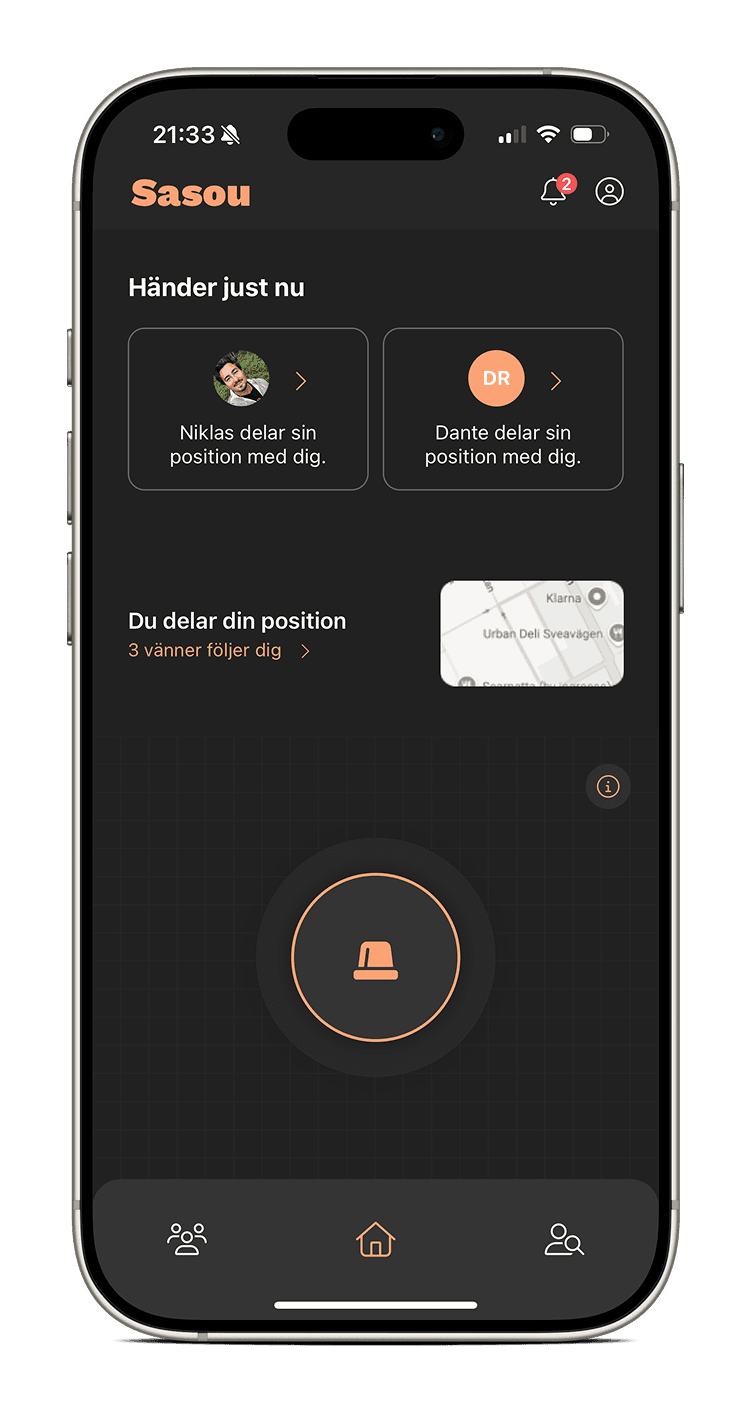
Happening now
Who is sharing with you and whether you're sharing, at the top. The alarm button sits at the bottom, where the thumb already is.
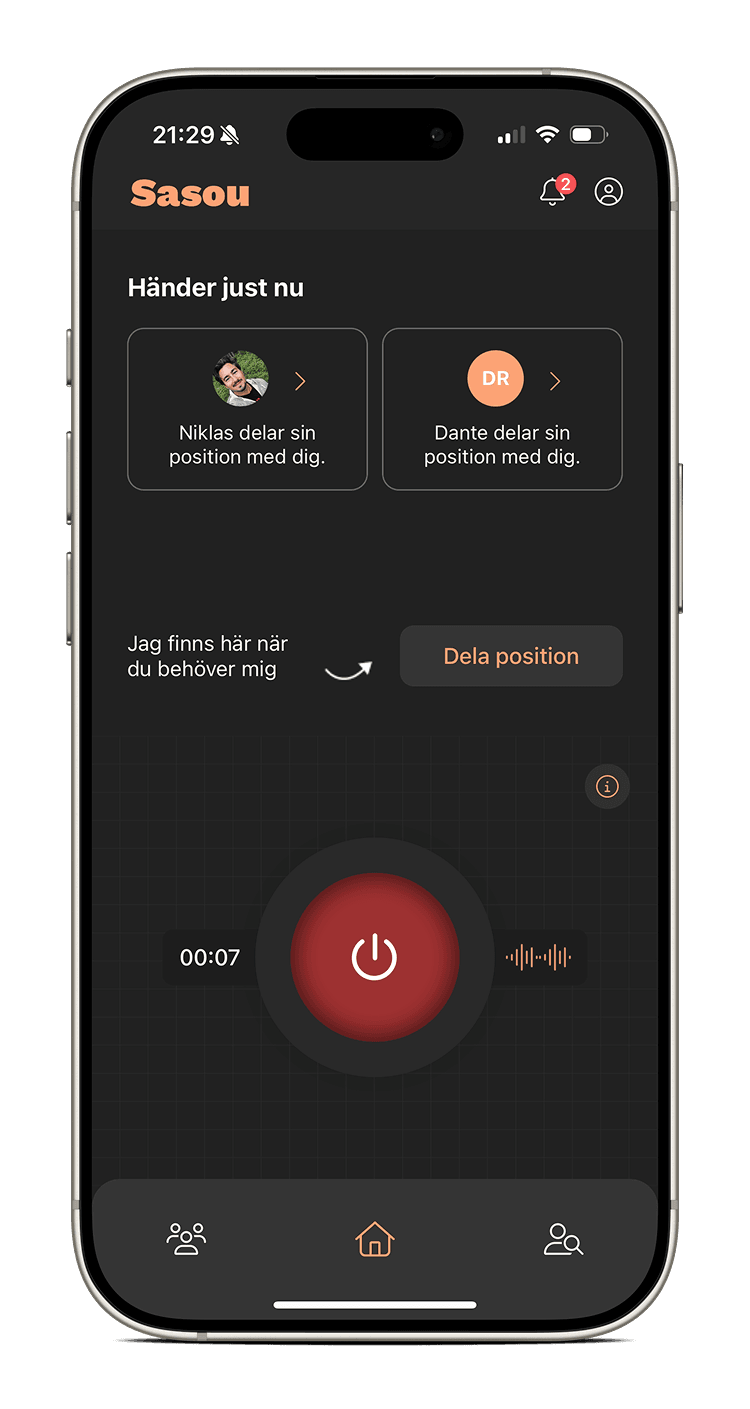
A countdown, not a panic button
Pressing the alarm starts a visible countdown you can cancel, so a pocket press never wakes up your friends.
Choose who sees you
All friends, a group or a hand-picked few. Sharing is a decision you make each time, not a setting you forget.
Groups and friends
Private groups only their creator can see, for the people you'd actually call.
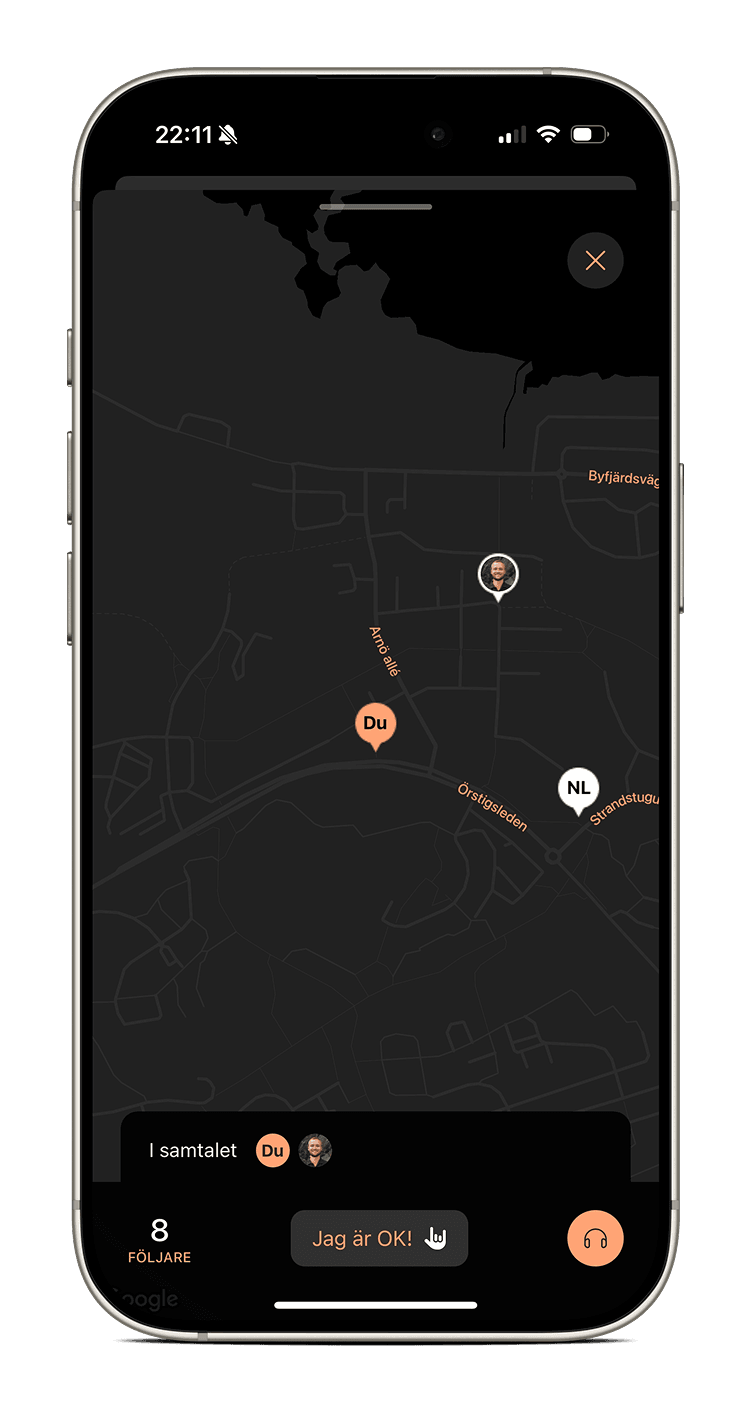
Live, never stored
Positions are shared live on a dark map and never kept as history.
Design system
The system
The consumer app used a warm peach on a dark base: friendly, not alarming. The MVP deliberately ran on neutral placeholder tokens, since custom design was out of scope for the trial.
System font (SF Pro / Roboto)
Everything
- One app with two roles: anyone can start a session, and responders get a "Safety circle" tab
- Responders see "Acknowledged by…", so the circle knows someone has it
- Swedish and English
Outcome
Where it landed
The consumer app was built for iOS and Android with live sharing, alarms, groups and video huddles. The B2B MVP was built for a roughly 30-day trial, to learn whether employees start sessions, use Heads-Up when needed, and whether their safety circle responds, before building the larger platform. The company has since been voluntarily liquidated (2026).