Verundo
AI agents now change real CRM records, calendars, tickets and payments, and none of those systems can undo a run. Verundo records every action an agent takes, with enough state to reverse it, and gives the operator one rollback for the whole run. Verundo is a Techtify Labs product, and I built all of it: I designed and built the application, dashboard, website and brand.
- Role
- Product design · Build
- Platforms
- Web app · Website · MCP server
- Team
- Solo: designed and built by me
- Made at
- Techtify Labs · in-house product
- Disciplines
- Product design · UI/UX · Brand · Front-end
- Online
- verundo.io
Context
An agent can do an allowed thing for the wrong reason, in several systems at once. HubSpot, Slack and Google Calendar were built for people, so they share no transaction layer. When an agent writes a deal ten times too large, books the kickoff and announces it in Slack, someone fixes four systems by hand and hopes they found everything.
Who it's for
Teams that run AI agents against their business systems, and the ops or engineering lead who has to decide what an agent may do on its own.
Constraints
- 01Rollback writes to live third-party systems. It must never overwrite work a person did after the agent.
- 02Some actions can't be undone: a sent email, a refund. The interface has to say so instead of pretending.
- 03It started as an investor demo on real APIs, with no mocks. The story had to land in under six minutes.
- 04Dense data, like before and after state and field-level diffs, read by someone who is already worried.
My role
Verundo belongs to Techtify Labs, and I built it end to end. I shaped the product model (runs, actions, rollback, policy), then designed and built the application, the operator dashboard, the public site and the visual identity. I also wrote the demo script, which shaped what the product had to make obvious.
- Product model: a run as one recoverable object
- Dashboard: transaction log, live run view, rollback plan, conflict handling, policies
- Brand identity and a token file shared by the product and the site
- Marketing site, sign-up and pilot pages
- First-run experience: a welcome card with three ways in instead of a tour
- Six-minute investor demo against real HubSpot, Google Calendar and Slack
Key decisions
The calls that shaped it
A plan before the rollback
- Problem
- An undo button that fires at once is frightening when it touches four live systems. The operator only finds out what happened afterwards.
- Decision
- Rollback run opens a read-only plan first. Verundo re-reads every system, then lists each action with its outcome: restore, compensate, conflict, will skip or effect remains, plus a time estimate. Nothing happens until Confirm rollback.
- Why
- The plan is where trust is built. It is based on live state, not on the log, so it shows what will actually happen. A scary button becomes a reviewed decision.
Stop at the human
- Problem
- Between the agent's run and the rollback, a colleague may move the deal to a new stage. Restoring the old value would erase their work.
- Decision
- Rollback runs in reverse order and stops on any object that changed from outside. A conflict card shows the field in three columns: before, what the agent wrote, and what it is now. Two choices: Keep current state, or Revert external change, which gets its own confirmation. Earlier actions on the same object are skipped, and the row says why.
- Why
- Verundo never decides this. It stops, shows both states and records which person chose what. Drift is flagged on the row as soon as it's detected, before anyone presses rollback.
Policy by consequence, not by tool list
- Problem
- Permission screens usually list every tool with a switch. With dozens of actions across eleven systems, nobody can reason about that.
- Decision
- The policies page groups actions into three classes, reversible, compensatable and irreversible, and gives each one decision: agents may execute, needs approval, or denied. Irreversible actions need approval by default. Per-action overrides, containment limits and an amount guard sit below.
- Why
- The real question is "what if this is wrong?". Grouping by reversibility answers it and moves the conversation from tool names to consequences. When the guard holds a deal, the reason is on screen ("10× the typical deal"), so a person decides with the evidence in front of them.
Verified means re-read
- Problem
- An API returning OK doesn't prove the record is gone. And some effects can't be reversed at all, but a green checkmark would hide that.
- Decision
- A row only says verified after Verundo re-reads the system and confirms the state. Every other ending has its own plain label: conflict, kept current, skipped, unverified, effect remains. The result counts both, as in "Actions reversed 6/6 · External state verified 6/6".
- Why
- Operators need to be able to trust the colour. "Effect remains" next to a sent email is less comforting than a tick, but it's true. For this product, being honest is the feature.
Responsive
Explaining an undo button
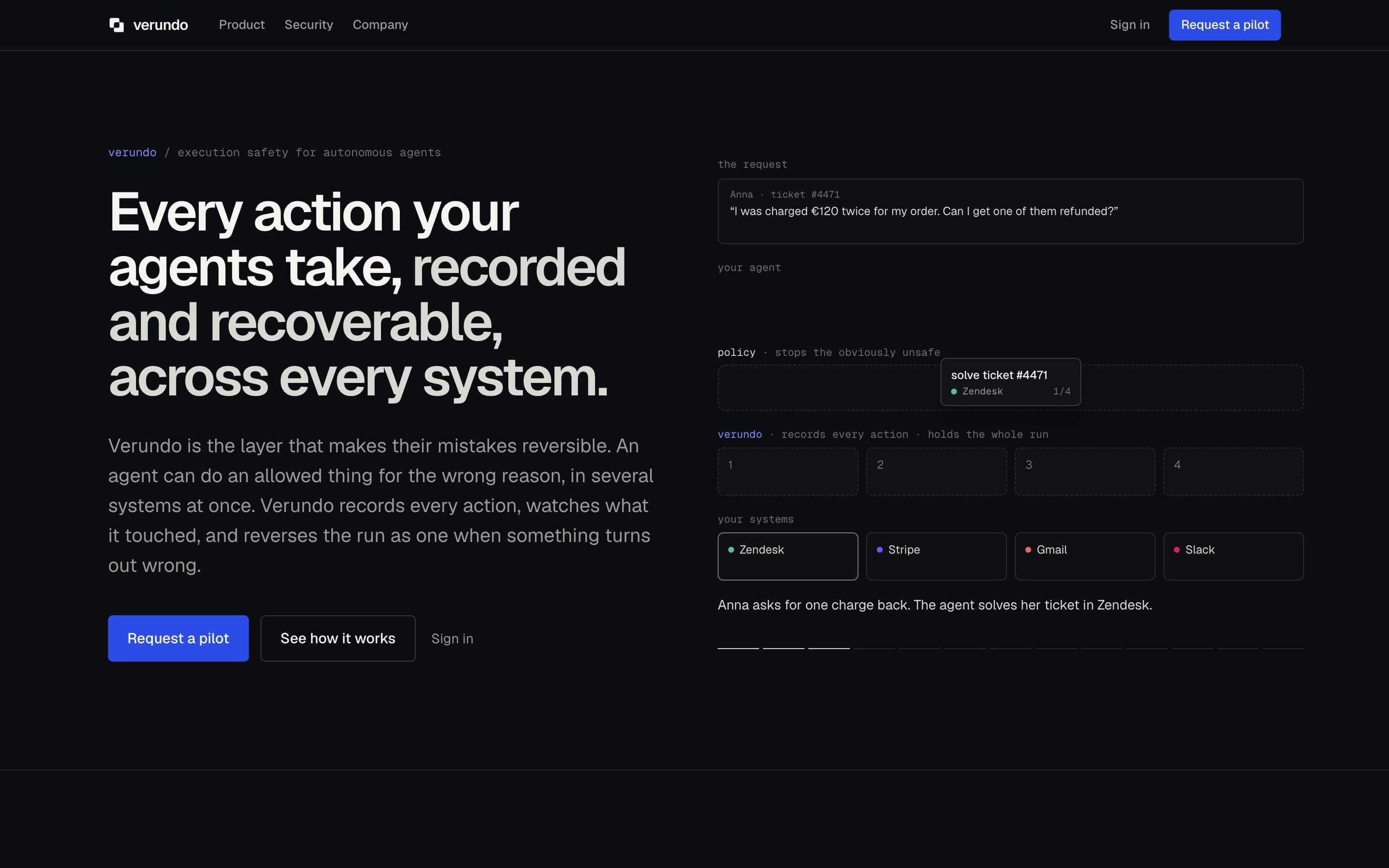
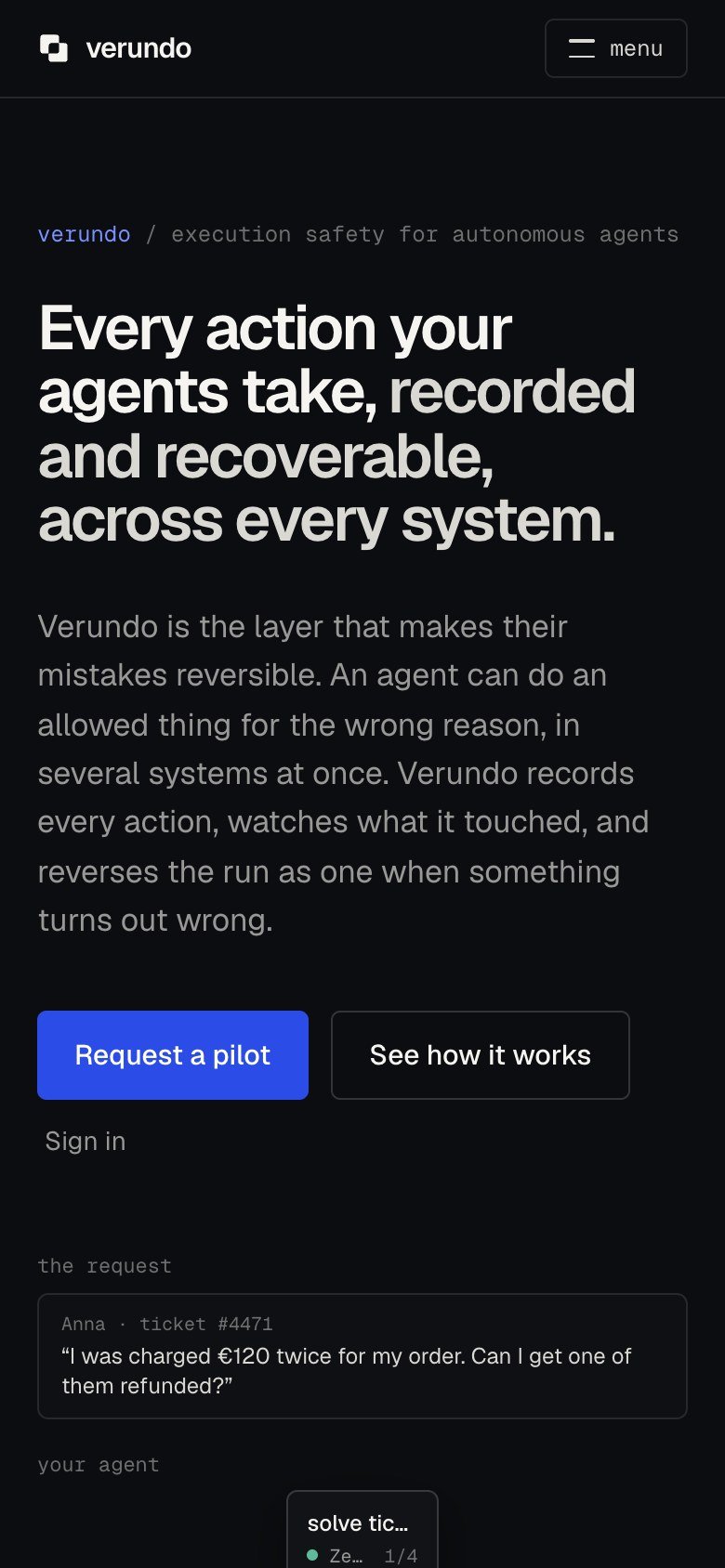
Reversibility is abstract, so the site shows it: a run, a rollback plan and a verified recovery, animated in the product's own language.
The hero walks through one agent run and its rollback, instead of a feature list. · 1440 px
Design system
The system
A graphite dark UI with one cobalt, used for action and signal. The product and the public site share one token file.
Geist
Headings at 600 with tight tracking, body at 400
Geist Mono
Labels, ids, amounts and field diffs, with tabular numbers
- Small lower-case mono labels (rollback plan, autonomy policy) instead of heavy section headings
- Provider colours only mark which system a row belongs to
- Status is carried by words first, colour second
“Cobalt is a signal, not a fill. One primary action per screen.”
— Verundo design tokens
Outcome
Where it landed
Verundo runs as a hosted product at verundo.io, with sign-up and a hands-on pilot offer. The investor demo goes from undo to refusing to overwrite a person to prevention, all against real HubSpot, Google Calendar and Slack. Any MCP-capable agent can connect without code changes.